How Much Does Hail Damage Roof Repair Cost in 2026?
By the Trusted Home Quotes Editorial Team | Updated October 2026
Hail damage roof repair costs can be as little as
$150 to $1,000
for the smaller fixes, while more involved repairs commonly land between
$1,000 and $3,000.
Once damaged decking, several roof sections, or water intrusion get involved, the bill can climb to
$3,000 to $6,000 or more.
That then prompts a bigger question: is your roof actually in need of repairing, or did the storm do enough damage to make replacing it whole the better option?
That difference holds the weight of turning a few-hundred-dollar job into a five-figure project.
Get a Price for Your Roof
National ranges tell you whether you might be looking at hundreds or thousands.
Your roof tells you the actual number.
If you suspect hail damage, compare free roofing quotes from local professionals through Trusted Home Quotes. Completely free with no obligation, and you can compare what each contractor is actually proposing before making any decisions.
Key Takeaways
- Minor hail-related roof repairs can cost around $150 to $1,000.
- More substantial repairs typically run $1,000 to $3,000, with major damage reaching $6,000 or more.
- Your roof material, damaged area, accessibility, and any hidden water damage all move the price.
- A full roof replacement typically costs $7,500 to $16,000 for most single-family homes in 2026.
- Insurance may cover hail damage, but your deductible, roof age, depreciation, and policy terms all matter.
Hail Damage Roof Repair Cost at a Glance
| Damage level | Typical cost | What that might mean |
| Minor | $150–$1,000 | A few damaged shingles, small leak, sealing |
| Moderate | $1,000–$3,000 | Larger damaged area, decking or water repairs |
| Major | $3,000–$6,000+ | Several roof sections, significant water or structural damage |
| Full replacement | $7,500–$16,000 typical | Widespread damage across the roof |
Here is where hail repair gets tricky:
two homes on the same street can come out of the same storm with completely different bills.
One might need a handful of shingles replaced. The other might have damage across several slopes, cracked flashing, battered gutters, and water getting below the roof covering.
That is why the useful question is not simply “How bad was the hail?” but what did it actually damage?
What Actually Changes the Price?
How Much of the Roof Was Hit
A few damaged shingles are one thing. Damage spread across multiple sections of the roof is another.
When it comes to minor roof repairs, things like missing or damaged shingles can stay in the hundreds. But when a roofer has to open larger sections, replace underlayment, repair decking, or chase a leak below the surface, costs can vary into the thousands.
This is also why a professional inspection can be worth doing after experiencing a serious storm. A roof that looks fine from the driveway can still have damage you cannot see safely from the ground.
A standard professional inspection typically costs around $125 to $376 according to our current
roof inspection cost guide.
Your Roofing Material
Material makes a big difference.
Asphalt shingles are common, easy for most roofers to source, and usually one of the least expensive materials to repair. However, slate and tile will be on the opposite end because the material costs more and the repair itself takes more specialized work.
Metal falls somewhere in between depending on the system. A small cosmetic dent may not need repairing at all, while damaged panels or seams can turn into a much larger job.
If hail damage has you considering a different material altogether, our metal roof cost guide
breaks down what current installations cost.
Roof Size, Pitch, and Access
Roofers measure roofing in squares, where one square equals 100 square feet of roof surface.
For a small repair, the damaged section would be accounted for more than your home’s total size. That ends up changing when the damage is widespread enough to start talking about replacement.
How steep your roof is also accounts for how long the work will be. Add a second story, dormers, valleys, skylights, or difficult access, and the labor portion of the quote will keep going up because the job is slower and requires more safety equipment.
What Is Hiding Under the Shingles
Hail can already do damage to roof coverings, but when you deal with a leak that gets through, it can reach the underlayment, decking, insulation, ceiling, or walls.
A roof deck repair alone can run around $200 to $500 per 100 square feet, while substantial water-damage restoration can reach $1,500 to $5,000 or more.
If you are already seeing stains, dripping, or a damp smell indoors, our guide to the signs of a roof leak explains what to watch for.
Hail Damage Repair Cost by Roof Material
| Roofing material | Typical repair cost per 100 sq. ft. |
| Asphalt shingles | $350–$1,000 |
| Metal | $500–$1,500+ |
| Wood shake | $500–$1,500 |
| Clay or concrete tile | $500–$2,500 |
| Slate | $1,000–$3,000 |
These numbers are broader repair ranges for each roofing material, not a quote for hail damage specifically. Your actual price will depend on what has to be removed, repaired, and replaced.
Asphalt Shingles
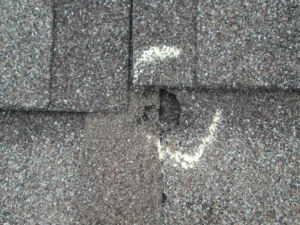
Hail proves an issue as it can knock away protective granules, bruise the shingle, or crack the material underneath.
A few damaged shingles usually calls for a straightforward fix. Widespread damage across several roof slopes is where the repair starts entering replacement territory.
Metal
Metal is able to hold up well in severe weather, but with hail, there will be dents.
The important distinction here though is cosmetic versus functional damage. A visible dent isn’t automatically a leak, while damaged seams, fasteners, or panels can require a proper repair.
Tile, Wood, and Slate
Wood can split under hard impacts, while clay, concrete, and slate can crack or break.
These types of materials generally run higher in cost when repairing due to the individual pieces and labor being more expensive, and trying to match older roofing can sometimes be difficult.
Does the Roof Need Repairing or Replacing?
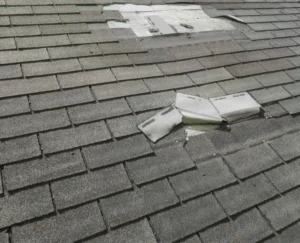
When it comes to the dilemma we’ve been leading up to, not every hail-damaged roof needs replacing.
When you see the damage concentrated in a small area and the rest of the roof still has plenty of life left, a simple repair may be all you need.
Replacement becomes more realistic when you have damage spread across much of your roof, the decking or underlayment is compromised, multiple areas are leaking, or the existing roof is already nearing the end of its useful life.
| Repair may make sense when… | Replacement may make sense when… |
| Damage is limited | Damage is widespread |
| Most of the roof is still healthy | The roof is already near the end of its life |
| Matching materials are available | Matching older materials is difficult |
| Decking is still sound | Decking or underlayment is damaged |
| There are no widespread leaks | Several areas are leaking |
If replacement comes up in your estimate, it helps to know what that means financially before making the call.
In 2026, most full roof replacements fall around $7,500 to $16,000, with an average close to $11,000. You can see the full size and material breakdown in our roof replacement cost guide.
Don’t Forget the Rest of the Roof System
The shingles tend to get all the attention after hail, but they are only one part of the bill.
| Possible extra repair | Typical cost |
| Flashing repair | $200–$500 |
| Roof vent replacement | $200–$700 |
| Roof decking | $200–$500 per 100 sq. ft. |
| Wet insulation | $100–$450 per 100 sq. ft. |
| Gutter repair | $200–$600 |
| Significant water damage | $1,500–$5,000+ |
These are the costs that can turn what looked like a simple shingle job into a larger repair.
Gutters deserve a look too. They often take the same hit as your roof, and dents or damaged sections may affect drainage. If yours are beyond a small repair, see our current gutter replacement cost guide.
Will Homeowners Insurance Pay for Hail Damage?
Oftentimes, yes, but do not rely on the assumption that the insurer will cover the whole roofing bill.
The exact amount depends on what your policy covers, your deductible, your roof’s age and condition, and whether the policy settles the damage using replacement cost or actual cash value.
RCV vs. ACV
This one matters.
With replacement cost value (RCV) coverage, the policy generally pays the cost to repair or replace damaged property with something of similar kind and quality, subject to the policy terms.
With actual cash value (ACV) coverage, depreciation is taken into account. That means an older roof may result in a smaller payout even when the hail damage itself is covered.
Some policies tend to have separate wind or hail deductibles, and coverage rules can vary by insurer and state.
In other words, your roofing estimate and your insurance check are not automatically the same number.
We’d advise you to read the policy and ask the insurer to explain anything you do not understand before approving major work.
What Should You Do After a Hailstorm?
First, stay off the roof.
You can learn plenty without climbing a ladder:
- Photograph obvious damage from the ground.
- Check gutters, downspouts, siding, vents, and other exposed areas.
- Look inside for new water stains or leaks.
- Review your insurance policy.
- Contact your insurer if you believe the damage may be covered.
- Arrange a roof inspection if there are signs of damage.
- Get detailed written estimates before committing to major work.
- Save your photos, inspection reports, invoices, and insurance correspondence.
How to Keep the Repair Bill Under Control
Compare the Work, Not Just the Total
You can look at three different roofers and they can give you three different numbers because they may be proposing three different jobs.
Make sure to look for an itemized quote that tells you specifics of what is being replaced, what happens if damaged decking is found, disposal handling, the types of materials being used, and the warranty that comes with the work.
When you see a dramatically cheaper quote, it does not necessarily mean a bargain if half the repair is missing from the scope.
Deal With Leaks Quickly
There is a clear difference between stopping water from getting in and agreeing to a whole new roof.
If you see your roof actively leaking, temporary protection may make sense straight away. You can always compare permanent repair options once you know the house is protected.
Be Wary of Pressure After a Storm
After dealing with major weather events, it can start attracting legitimate roofing companies, but that means there’s an opening for some roofer with bad intentions.
Make sure to validate contractor credentials, get written estimates and contracts, and flag whenever anyone demands the full project cost upfront.
Even in times of urgency like these, take your time to understand what you are signing, especially when an insurance claim is involved.
Are Impact-Resistant Shingles Worth Considering?
When the roof is due for a replacement anyways and you live somewhere that regularly gets hail, it is worth asking about impact-resistant shingles.
But “impact-resistant” does not mean “hail-proof.”
The Insurance Institute for Business & Home Safety tested 24 impact-resistant asphalt shingle products in its 2025 ratings and found meaningful differences between products. IBHS uses laboratory-made hailstones to compare how shingles respond to damage such as dents, tears, and granule loss.
Ask your roofer about the added material cost and whether your insurer offers any relevant discount before deciding.
How Trusted Home Quotes Gets Its Cost Data
Our ranges are researched from current U.S. cost databases, industry sources, insurance guidance, government information, and current contractor pricing.
They are useful for getting your budget in the right neighborhood. They are not a substitute for someone actually looking at your roof.
Hail damage is especially difficult to price from a national average because a small cluster of damaged shingles and a storm-damaged roof deck are simply not the same job.
Frequently Asked Questions
How much does it cost to repair hail damage on a roof?
Minor roof repairs can cost around $150 to $1,000. Moderate repairs generally run $1,000 to $3,000, while major roof and water-damage repairs can reach $3,000 to $6,000 or more. A full replacement will start getting into 5-figures.
Does homeowners insurance cover roof hail damage?
Many homeowners policies cover sudden hail damage, but coverage will vary from one policy to another. Your deductible, roof age, exclusions, depreciation, and whether you have replacement cost or actual cash value coverage can all affect the amount you receive.
Can hail damage be repaired without replacing the roof?
Yes. If functional damage is only within a small area and the rest of the roof is in good condition, localized repair may be what’s good enough for the job. Replacement becomes more likely when the damage is widespread or water has reached materials underneath the roofing.
How can I tell if hail damaged my roof?
Even from the ground, you can notice damaged shingles, dented gutters or vents, loose roofing material, or signs of water inside the home. Hail damage can be bothersome to see sometimes, so a professional inspection can be worthwhile after a severe storm.
What size hail damages roofs?
There is no single size that guarantees roof damage. The National Weather Service classifies hail at 1 inch in diameter or larger as severe, but actual roof damage will depend on roofing material, age, condition, wind, and characteristics of the storm.
How soon should I have my roof checked?
If you see obvious exterior damage, a new leak, or water staining after a hailstorm, try to deal with it as quickly as possible so it doesn’t turn into a bigger issue for you, even if that means a temporary fix before calling someone. Insurance reporting requirements vary, so check the terms of your own policy instead of assuming a universal deadline standard.
You Might Also Like